Treat a bird dog as a quiet trunk with moving limbs
The bird dog begins on hands and knees and commonly extends an opposite arm and leg. The useful task is controlled limb movement around a steady torso. This guide focuses on support, coordination and the return, using a version appropriate to the learner rather than a balance spectacle.
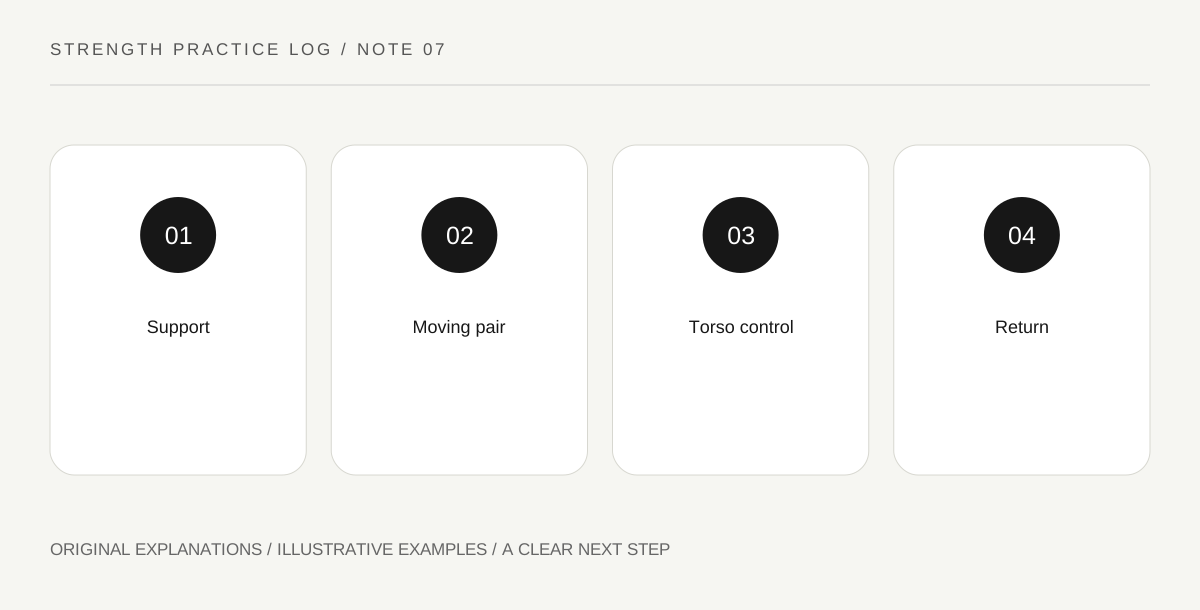
Original explanatory diagram. Read the full method and limitations below.
Make the support arrangement understandable
Ask the instructor to demonstrate the hand, knee and torso position for the selected variation. A suitable surface and manageable pressure at the support points matter. If hands-and-knees work is uncomfortable or inaccessible, discuss another appropriate option rather than improvising a precarious pad arrangement. The setup should be understood before a limb leaves the floor. A photograph of someone balancing does not show whether that version is suitable for you.
Choose the moving pair before reaching
The common opposite-limb pattern pairs one arm with the other-side leg. Say the pair aloud if that helps coordination. A simpler instructed version may move fewer limbs at first. Keep the actual variation in the notebook, because one-arm movement and simultaneous opposite-pair movement are different tasks. There is no requirement to skip directly to the longest or least-supported shape merely because it looks more recognizable in a demonstration.
Observe the torso rather than chase height
The arm and leg move while the instructed trunk position remains controlled. Lifting higher is not the only possible progress measure and can change the torso position unintentionally. Ask which range and cue apply to the lesson. A short appropriate reach may make the intended control clearer. Avoid comparing the silhouette with another person's flexibility or using a wobble as proof that a specific joint needs a self-prescribed corrective routine.
Return to the base deliberately
The moving limbs should return under control before the next instructed action. Dropping the hand or knee changes the transition and can obscure what happened near the end of the reach. Record which phase was difficult: leaving the floor, holding the intended position or returning. This makes the next question useful. The bird-dog lesson is complete when the movement task is understood, not when the learner has remained in an unstable position for an arbitrary amount of time.
Illustrative worked example
Illustrative coaching conversation: A learner finds the opposite-pair pattern confusing and begins lifting the same-side arm and leg. He pauses, names the intended pair and follows an instructor-selected simpler version. Later he records that the return is less controlled than the reach. The notebook gives two distinct learning questions rather than a general statement that balance is bad. No hold duration or outcome is prescribed in the fictional example.
Questions that come up
Must the arm and leg be lifted as high as possible?
No. Use the appropriate instructed range while preserving the intended torso task. Height alone does not define the exercise’s quality.
Can I simplify the coordination?
An appropriate simpler version may be useful, but choose it through suitable instruction when unsure. Record the change so you know which task you actually practised.
References and scope
These sources support the factual background. Examples and exercises are original illustrative teaching material. References do not imply endorsement.
- NASM Bird Dog — Opposite arm and leg extension from hands and knees.