Distinguish ankle flexion from moving the whole leg
A resisted ankle-flexion exercise asks the foot to move toward the shin while the rest of the leg remains arranged as instructed. It is a specific exercise to learn, not a home test for an injury. Use a suitable setup and professional guidance where the movement or its purpose is unfamiliar.
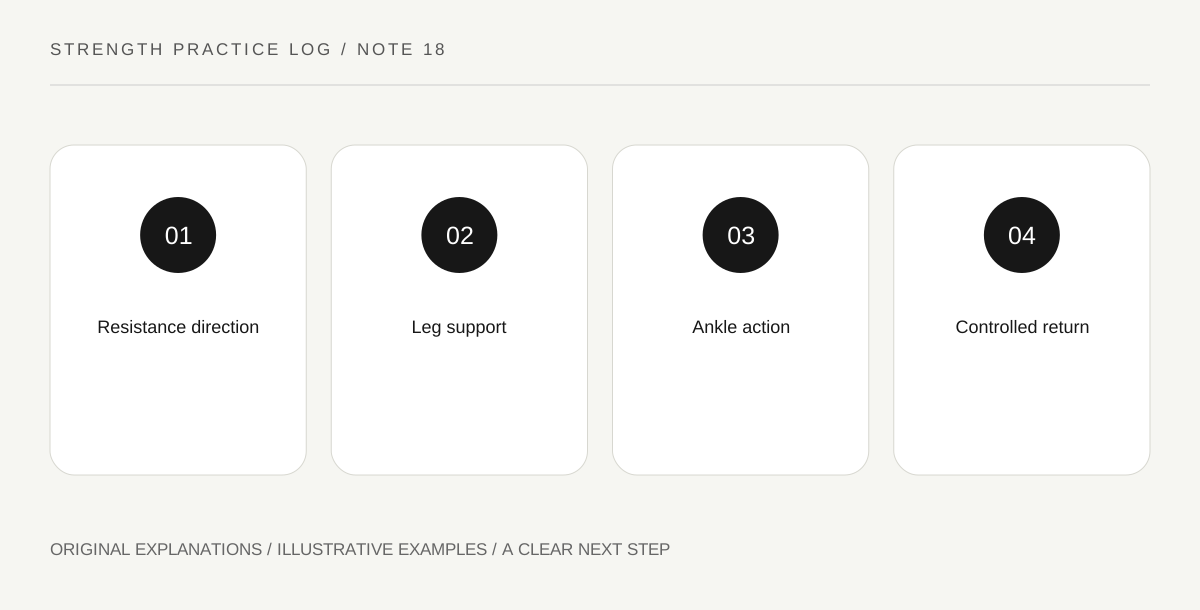
Original explanatory diagram. Read the full method and limitations below.
Identify the direction of resistance
ACE's reference uses a band or cable around the ball of the foot so resistance opposes the toes moving toward the shin. Ask an instructor to demonstrate a suitable attachment and position. Inspect and use equipment according to its instructions. Do not improvise an anchor that can release toward the body. The exercise name alone does not explain where the resistance should pull or how the equipment should be secured.
Arrange the leg before asking the ankle to move
The reference uses a seated position with the working leg extended. Learn an appropriate support arrangement for the version you are taught. A comfortable seated position should not require straining to hold the torso upright or forcing the knee into an unsuitable endpoint. Describe any fit or comfort issue to the instructor. Keep this exercise separate from standing balance tasks, which involve different contacts and demands despite also using the ankle.
Observe the foot rather than the knee
The intended action brings the toes toward the shin through ankle movement. Bending the knee or pulling the whole leg toward the body can change the resistance without performing the same task. Watch the relationship between the foot and lower leg. A small controlled movement may make that relationship easier to understand than a larger motion with several joints moving. Do not force the foot through discomfort to produce a greater visible angle.
Return against the resistance deliberately
Allow the foot to move back through the selected range under control. The band should not pull the ankle abruptly into its endpoint. Record the resistance direction and the part of the movement you want clarified. A notebook entry can support a coaching discussion, but it cannot establish why an ankle hurts or select a rehabilitation plan. Persistent symptoms or injury concerns need an appropriate health professional rather than repeated self-testing with more tension.
Illustrative worked example
Illustrative lesson: A learner initially bends his knee as he tries to move against a band. An instructor explains the intended ankle action and checks the attachment. The learner records resistance direction and notices the return is less deliberate than the pull toward the shin. No injury is diagnosed, and no claim is made that a particular tension or number of repetitions is suitable for rehabilitation.
Questions that come up
Is this a test for the cause of ankle pain?
No. A movement observation does not diagnose a problem. Seek appropriate professional advice for symptoms or injury concerns.
Should I increase tension until the motion feels difficult?
Select resistance through suitable instruction. Difficulty alone does not confirm that the setup, range or purpose is appropriate.
References and scope
These sources support the factual background. Examples and exercises are original illustrative teaching material. References do not imply endorsement.
- ACE Ankle Flexion — Band-resisted ankle movement and setup.