Keep a dead-bug reach inside the trunk position you learned
The dead bug combines lying on the back with controlled limb movement. The challenge is not to reach as far as a photograph shows, but to keep the instructed trunk position while the limbs move. Learn an appropriate version with a qualified instructor before treating it as a timed endurance task.
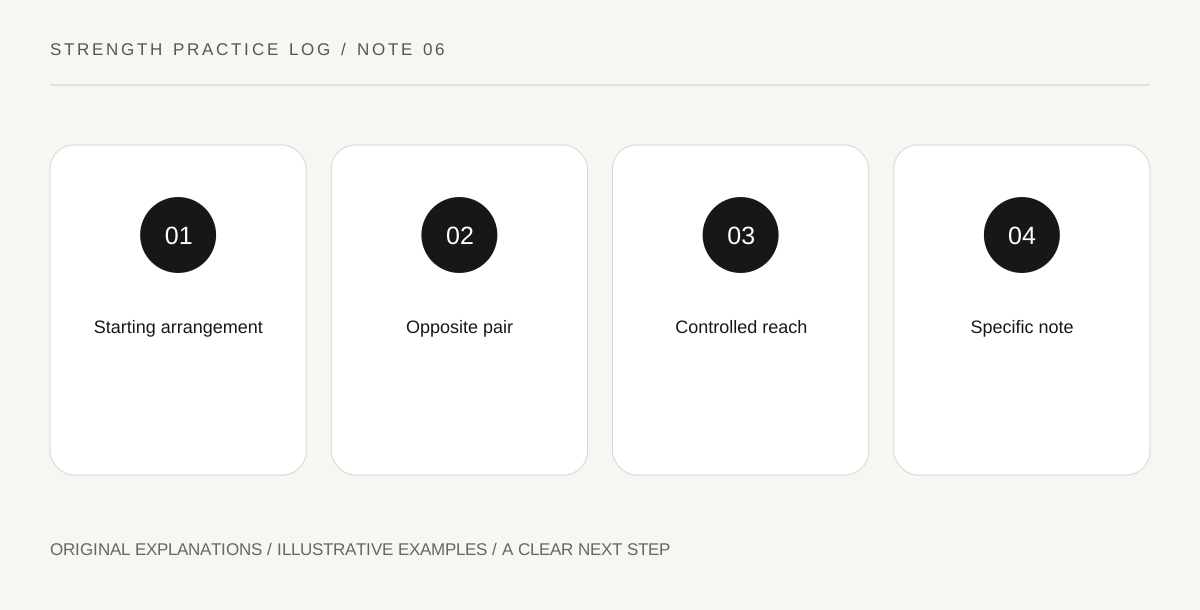
Original explanatory diagram. Read the full method and limitations below.
Establish the starting arrangement
The reference exercise begins lying on the back with arms raised and hips and knees bent. Ask the instructor to select the appropriate starting position and explain the intended trunk contact and breathing. If floor access or the position is unsuitable, another exercise or modification may be needed. The name does not require every learner to use the most extended version. Record the actual starting arrangement so the next session begins with the same understood task.
Move the opposite limbs deliberately
A common version reaches one arm and the opposite leg away, then returns before changing sides. Identify the pair before starting. Confusing the coordination pattern can make a learner rush or move several limbs without a clear task. Practise the instructed version slowly enough to know which limb is moving and which remains in place. The purpose is controlled coordination, not a demonstration that all possible limbs can be held off the floor at once.
Let control define the reach
As a limb moves farther away, the trunk task changes. Use the range the instructor has selected and stop the reach before losing the required position. Do not press or arch forcefully to imitate a generic cue that you do not understand. Ask the instructor to show what counts as the endpoint for you. A shorter reach performed within the intended task gives clearer learning information than a long reach completed through uncontrolled movement.
Write the phase that needs clarification
A useful note might say left-leg reach changes my instructed trunk position near the end. That is more specific than weak core and does not pretend to diagnose a muscle problem. Record whether the lesson used one limb, an opposite pair or another appropriate variation. The setup and movement pattern belong beside any repetition count. When a cue is unclear, bring the note back for instruction instead of adding load or extending the reach to prove progress.
Illustrative worked example
Illustrative learning record: A beginner practises an instructor-selected dead-bug version. He can coordinate the opposite pair but loses the instructed trunk position on a longer reach. He keeps the appropriate shorter range and asks for clarification at the next lesson. His note includes starting arrangement and moving limbs, rather than only a set count. The example claims no measured improvement and does not prescribe how far another person should reach.
Questions that come up
Is the farthest reach automatically best?
No. Range should fit the task and person. A longer reach that changes the intended trunk position is a different movement, not automatic progress.
Does difficulty prove a specific muscle is weak?
No. Coordination, setup and other factors can affect the lesson. Use a specific observation and qualified instruction rather than a diagnosis from one exercise.
References and scope
These sources support the factual background. Examples and exercises are original illustrative teaching material. References do not imply endorsement.
- NASM Dead Bug — Opposite-limb movement with trunk control while lying supine.