Keep a prone limb raise small enough to understand
Prone limb raises use a face-down support position while an arm, a leg or an opposite pair moves. ACE describes several versions, so the exact task needs a name. Learn an appropriate version and distinguish the limb action from lifting the head or arching the entire torso.
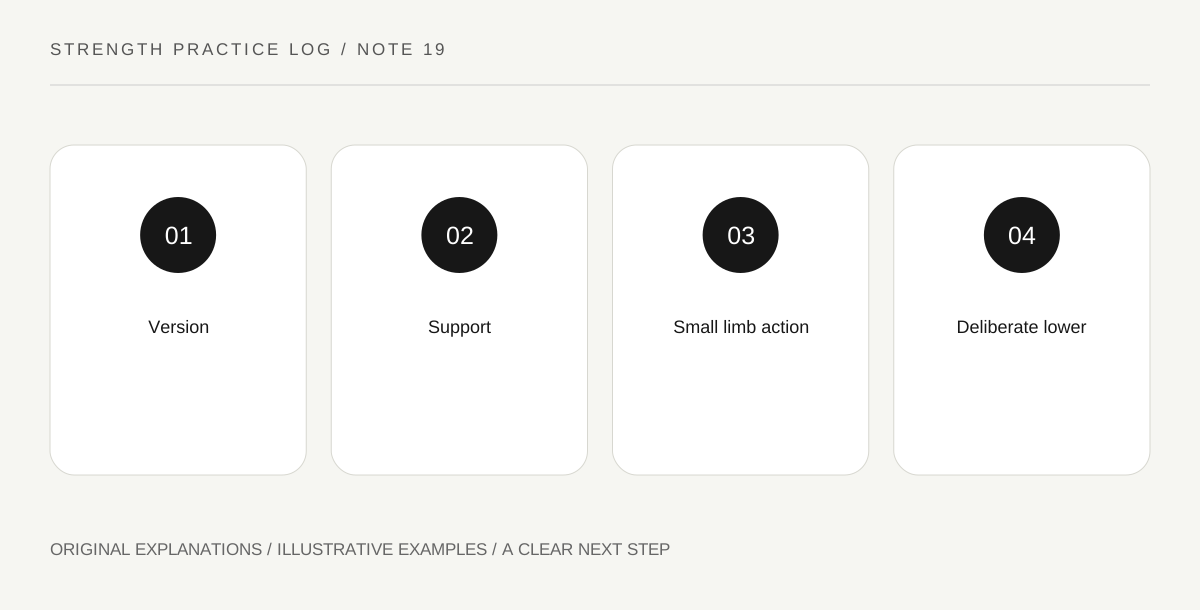
Original explanatory diagram. Read the full method and limitations below.
Choose the version before leaving the mat
A single-arm lift, a single-leg lift and an opposite arm-and-leg lift are different coordination tasks. Ask the instructor which is appropriate and record that choice. Do not begin with the most complicated version merely because it appears in a demonstration. The starting position should be suitable and comfortable. If lying face down or raising an arm overhead is unsuitable, ask about another option instead of forcing the reference position.
Understand the support and head arrangement
ACE's reference uses a mat, extended legs and arms overhead, with the head kept neutral. Learn how the head and torso should remain arranged in your version. Avoid turning the exercise into an upward gaze that pulls the neck back. The support surface and limb position matter because they determine what moves away from the floor. A photo of a high finish does not explain the control needed to get there or return.
Raise the intended limb without chasing height
The reference describes a small lift rather than a demand to raise every limb as high as possible. Observe whether the torso arches or rotates as the limb leaves the mat. Describe what changed to the instructor. A modest visible movement can still be the relevant learning task. Extra height obtained through a different trunk action should not automatically be counted as improvement or used to justify a harder version.
Lower before changing the task
Return the raised limb deliberately, then follow the instructed sequence for the next action. The return helps reveal whether the movement remains organized or ends in a drop. Record the chosen version, the support arrangement and the phase that became unclear. These details support another demonstration. They do not establish a diagnosis, prove that a particular back muscle is weak or justify performing the exercise through discomfort in pursuit of a correction.
Illustrative worked example
Illustrative coordination note: A learner is taught a single-arm prone raise. He notices his head lifting before the hand leaves the mat. After discussing the task with the instructor, he records the head arrangement and the small arm action separately. He does not upgrade himself to lifting all four limbs. The example describes a learning observation without prescribing duration, repetitions or a back-treatment plan.
Questions that come up
Is the version with every limb raised automatically better?
No. Different versions change the task. Choose an appropriate version through instruction rather than equating complexity or height with quality.
Should the head rise with the hand?
In the referenced exercise the head remains neutral. Ask an instructor to clarify the suitable head position for your version.
References and scope
These sources support the factual background. Examples and exercises are original illustrative teaching material. References do not imply endorsement.
- ACE Contralateral Limb Raises — Opposite limb lifting in the prone exercise.