Learn a bodyweight squat as a controlled down-and-up movement
A bodyweight squat can be a useful movement lesson before resistance is added. The task is to understand the start, lowering and return in a version appropriate to you. This guide gives observations to discuss with a qualified instructor rather than a universal depth target or a repetition challenge.
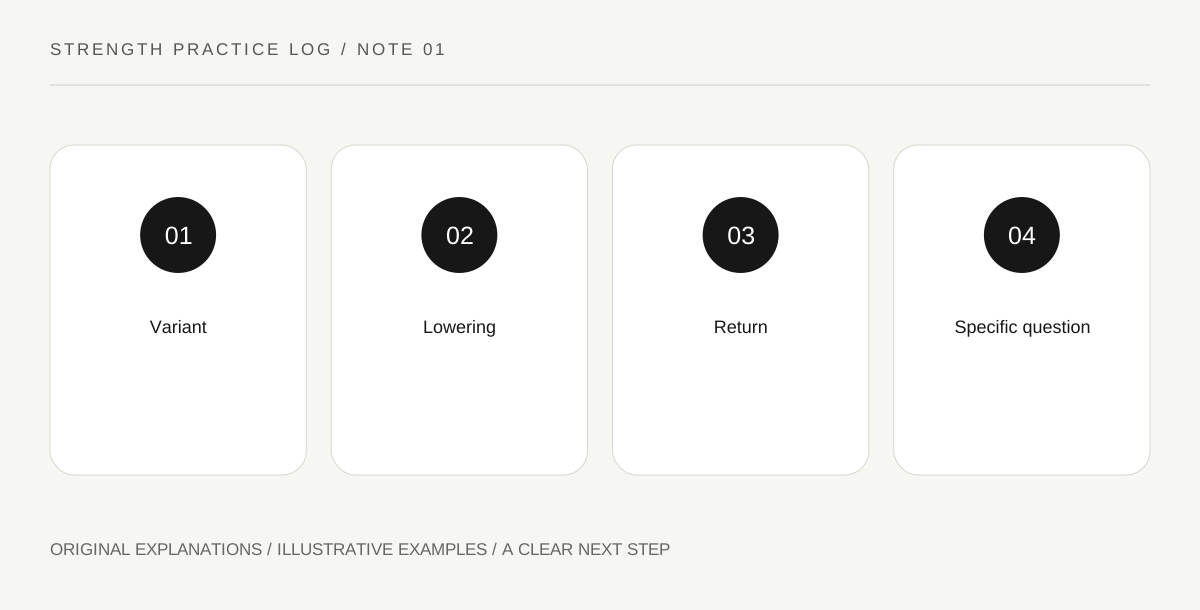
Original explanatory diagram. Read the full method and limitations below.
Identify the version you are learning
Ask the instructor to show the intended stance, comfortable range and any support appropriate to your current ability. A bodyweight squat is not automatically the same task as a loaded barbell squat. Name the actual version in your notebook. If a chair or other support is used, it needs to be suitable and stable for the instructed task. Do not improvise a support merely because it looks similar to one in a video.
Follow the hips and knees together
The basic squat lowers through coordinated hip and knee movement and returns to standing. Observe the movement as a whole rather than trying to freeze every joint into a copied photograph. Different people can present different comfortable outlines. Ask which cue is relevant to your own lesson. A social-media image of a very deep squat does not establish the range you should force or a reason to continue through pain.
Keep the return as deliberate as the lowering
Rushing upward or dropping into the bottom changes the task you are trying to learn. Use the instructor's appropriate pace and stop when control or comfort changes. You do not need to prove strength by adding fatigue before the pattern is understood. A short learning note can distinguish the part that felt clear from the part that needs another demonstration, such as starting the return without shifting onto an unintended edge of the foot.
Record an observation rather than a body judgment
Write a specific question: I lose the instructed position near the end of the lowering; what should I change? That is more useful than saying my body is wrong. The answer may involve the variant, support or range, and belongs to qualified instruction when you are unsure. Keep pain or concerning symptoms separate from ordinary learning difficulty and seek appropriate help. The goal is a movement you understand well enough to practise as instructed, not a score based on depth.
Illustrative worked example
Illustrative lesson note: A beginner learns a supported bodyweight squat with an instructor. He records the chosen support, the comfortable instructed range and one cue about controlling the return. He does not add weights after seeing another person's deeper squat. At the next lesson, he asks about the point where his movement becomes less controlled. The example reports a fictional learning process and makes no claim of measured improvement.
Questions that come up
Must every squat reach the same depth?
No. The appropriate task depends on the person and context. Do not force a copied position to satisfy an arbitrary visual target.
Is bodyweight practice too easy to matter?
The relevant question here is whether you are learning the intended movement. External load is a separate decision, not a requirement for a useful first lesson.
References and scope
These sources support the factual background. Examples and exercises are original illustrative teaching material. References do not imply endorsement.
- ACE Bodyweight Squat — Bodyweight squat movement and controlled return.
- NHS Strength and flexibility — General strength activity context and gradual appropriate exercise.