Keep the goblet position part of the squat lesson
A goblet squat places resistance in front of the torso, so holding and controlling that object is part of the exercise. Learn the grip and movement together with appropriate instruction. This guide does not choose a weight or assume that a front-held load makes every squat suitable for every person.
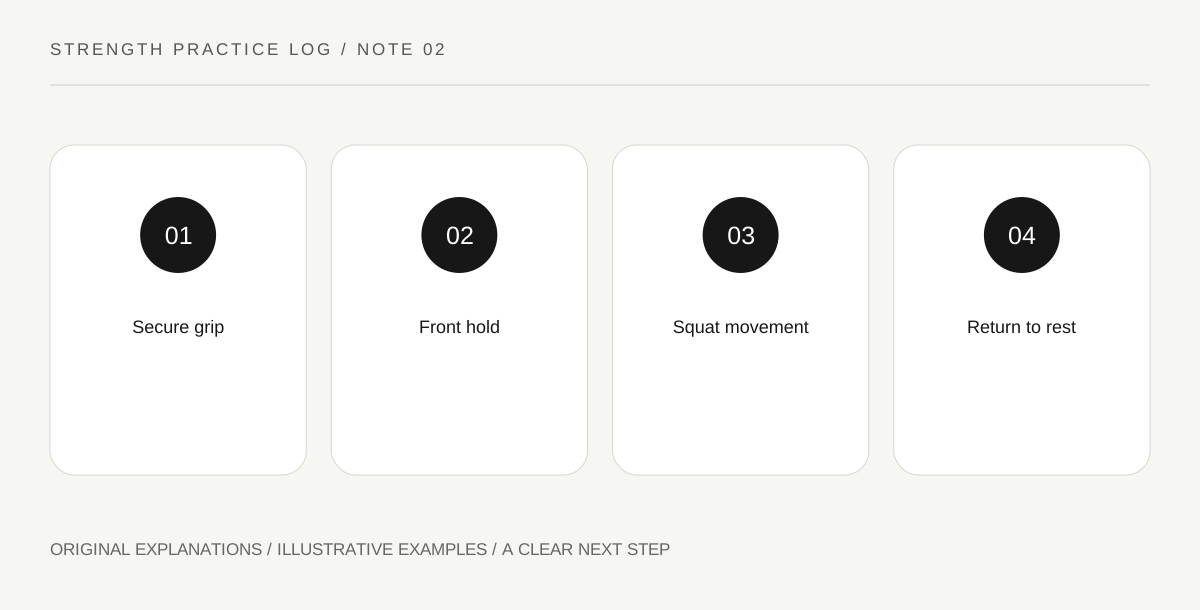
Original explanatory diagram. Read the full method and limitations below.
Identify the implement and its grip
A dumbbell and a kettlebell can require different hand arrangements. Ask a qualified instructor to show the intended grip and a suitable load for learning. Inspect the implement's condition and keep the start and finish area clear. The word goblet describes a front-held arrangement, not permission to use any heavy household object. A secure grip should be established before the lowering begins rather than improvised after the object starts to shift.
Observe where the load stays
The reference movement keeps the resistance close to the chest through the squat. A load drifting away creates a different practical demand. Ask the instructor how the position should relate to your torso and movement. Do not force a rigid copied outline if it produces discomfort. The learning question concerns controlling the chosen implement through an appropriate range, not achieving an exaggerated upright appearance at any cost.
Separate the hold from the leg task
A reader may find the grip or upper-body holding demand limiting before the squat movement itself is understood. State that specifically rather than concluding that the legs need a much heavier object. The instructor can help choose an appropriate variant or adjust the lesson. Avoid adding repetitions simply to prove that the hold is strong enough. The movement should remain controlled according to the actual instruction, with no need to turn the session into a maximum-effort test.
Plan how the object returns to rest
The exercise includes picking up and putting down the implement appropriately. Ask for a demonstration if that transition is unfamiliar. Do not finish a controlled squat and then drop or twist with the object because the counted repetition is over. Record the grip, hold position and return-to-rest method. Those details make the next practice more understandable than a note containing only the implement's weight and a number of completed repetitions.
Illustrative worked example
Illustrative coaching note: A beginner tries an instructor-selected goblet-squat variant. The leg movement feels manageable, but the object begins to drift away from the chest. He stops the practice and asks about grip and hold position rather than choosing a heavier implement. His notebook records the secure starting hold and the demonstrated way to return the object to rest. No load recommendation or performance result is implied by the example.
Questions that come up
Does holding the weight in front guarantee good technique?
No. It changes the exercise task but does not replace appropriate instruction or individual assessment.
Should grip difficulty be ignored because this is a leg exercise?
No. Holding the implement is part of the movement. Discuss the actual limiting task instead of continuing with a load you cannot control appropriately.
References and scope
These sources support the factual background. Examples and exercises are original illustrative teaching material. References do not imply endorsement.
- NASM Goblet Squat — Front-held resistance and squat movement.