Give a farmer carry a start point, route and finish
A farmer carry combines holding resistance with walking, so the route and set-down matter as much as the distance. Learn it with suitable instruction and an appropriate load. This guide focuses on the complete carrying task rather than a challenge to move the heaviest possible objects.
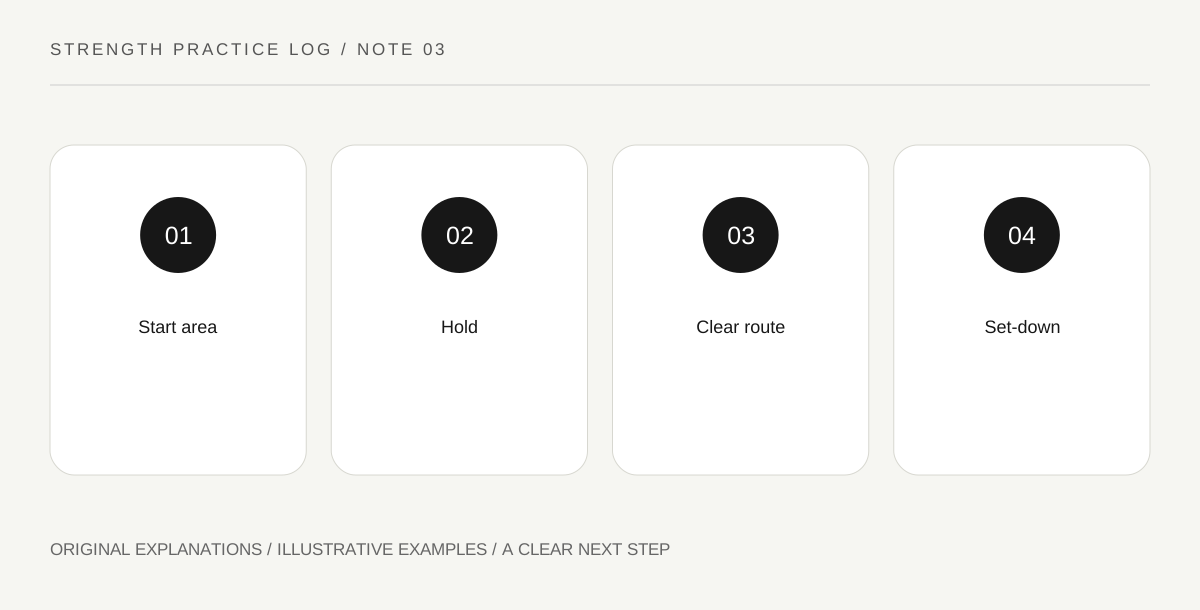
Original explanatory diagram. Read the full method and limitations below.
Choose the route before picking up
Use a clear appropriate path with enough room for the implements and your normal walking movement. Identify where the carry begins and ends. A crowded gym aisle is not a suitable route simply because it provides the desired distance. The practice should not require stepping around other users, turning sharply between equipment or carrying near objects that might be struck. Route planning is part of the exercise, not an inconvenience added afterward.
Learn the pickup and hold
Ask the instructor to demonstrate the appropriate pickup and implement position. Choose equipment intended for the task and a load you can control as instructed. A farmer carry often uses a load in each hand, but the exact variant should be named. Do not silently turn it into a one-sided carry while keeping the same note. The holding arrangement changes the task and should remain clear in the program or lesson.
Walk without turning the carry into a race
Follow the instructed posture and pace, keeping breathing and control manageable. The objective is carrying under the chosen conditions, not covering a distance as quickly as possible unless a qualified program specifically calls for another task. If grip, gait or comfort changes, stop appropriately rather than rushing to complete an arbitrary marker. A shorter controlled practice can answer a useful question about the movement without proving a maximum capability.
Finish with an intentional set-down
Reach the planned finish area and return the implements as taught. A fatigued grip is not a reason to drop equipment unpredictably or twist into a cramped storage position. Record the route type, implement arrangement and the part that needed attention. The distance is only one field. A complete note should let you reconstruct the carrying task safely and discuss an observed difficulty with the instructor before progressing.
Illustrative worked example
Illustrative route: An instructor selects suitable implements and a short clear path for a beginner. The learner marks an appropriate finish area before starting. During the lesson, he notices that turning is less clear than straight walking, so he asks for a turning or stopping demonstration instead of adding distance. His note records the two-hand variant, route and set-down. The fictional example supplies no weight, benchmark or promised training result.
Questions that come up
Is distance the only way to describe a carry?
No. Implement arrangement, route, turns, load and control all define the task. A distance without those details can be difficult to interpret.
Can I use a crowded walkway as the route?
Choose an appropriate clear training area. Do not make the exercise depend on navigating unpredictable obstacles or other people.
References and scope
These sources support the factual background. Examples and exercises are original illustrative teaching material. References do not imply endorsement.
- ACE Farmer Carry — Carrying dumbbells with a controlled upright walking pattern.