Keep the neutral grip visible in a hammer curl
The hammer curl is recognizable by its neutral hand orientation, with the palms facing inward toward the body. Learning that orientation, the elbow movement and the return gives a clearer task than simply lifting a dumbbell toward the shoulder. Choose suitable resistance through appropriate instruction.
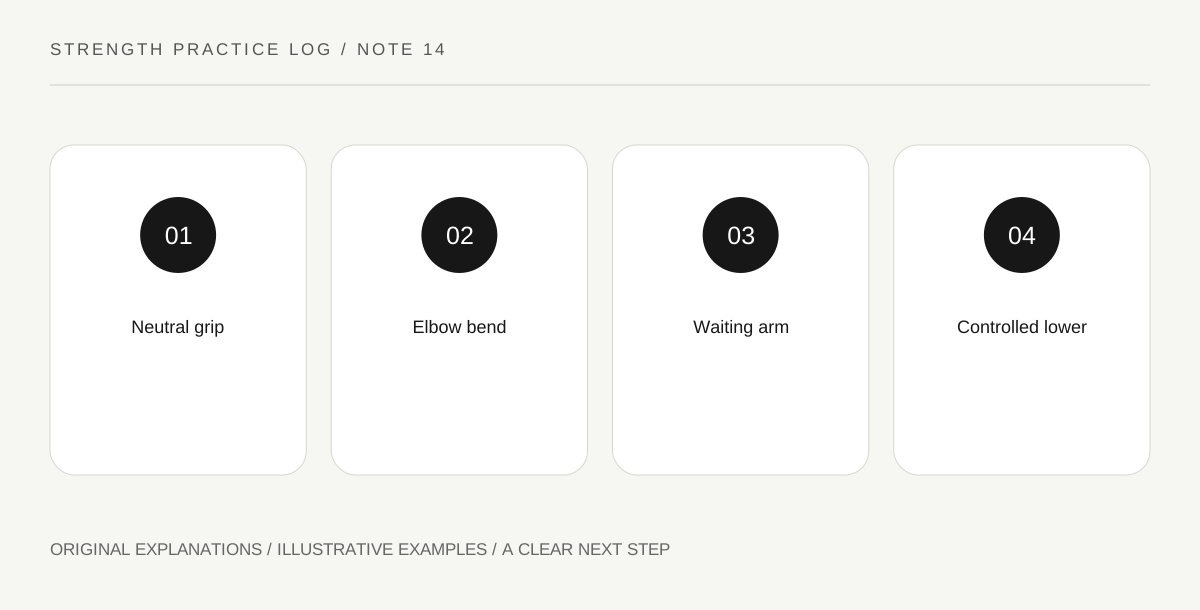
Original explanatory diagram. Read the full method and limitations below.
Establish the standing arrangement
ACE's reference demonstrates a stable standing position with the dumbbells beside the body. Learn a stance appropriate for your situation rather than copying a dramatic stagger or leaning against the load. Close the thumbs around the handles as demonstrated. Before curling, be able to explain where the weights start and what the hands face. This establishes the exercise variant before effort makes the movement harder to observe.
Preserve the hand orientation
In a hammer curl, the neutral grip remains part of the movement. Rotating the palms upward changes the variant, even if the dumbbells finish at a similar height. Keep the wrists from folding to manufacture extra handle travel. An instructor can help distinguish forearm rotation, wrist movement and elbow bending. Naming those actions is more useful than assuming that every dumbbell curl shown in a video is interchangeable.
Notice elbow and shoulder movement
The elbows bend while the upper body remains controlled. Watch for an elbow sweeping forward, a shoulder shrug or a body swing that moves the dumbbell beyond the intended arm action. These observations should become coaching questions, not a self-diagnosis. Ask about the selected resistance and range if the task changes. A completed lift is not automatically the same movement when momentum and body position differ substantially.
Name alternating and simultaneous practice
ACE describes curling one arm or both, with the nonmoving arm staying in its start position during an alternating version. Record which task you actually learned. Lower the dumbbell deliberately while maintaining the chosen hand orientation. If alternating, finish the return before the other side's instructed action. The distinction helps reconstruct coordination demands without treating one pattern as inherently superior or prescribing extra work for a perceived difference between sides. Keep that distinction visible.
Illustrative worked example
Illustrative notebook entry: A learner practices alternating hammer curls after a demonstration. He notices the waiting arm beginning to curl early and the moving wrist turning upward. He records those as separate coordination questions, then asks for another demonstration. The note identifies the alternating neutral-grip variant instead of merely writing dumbbell curls. It offers no load, repetition target or claim about correcting an imbalance.
Questions that come up
Is palm-up curling the same hammer-curl variant?
No. Hand orientation is part of the exercise description. Name the variant you actually perform so your notes remain useful.
Should the waiting arm drift upward during alternating practice?
Follow the demonstrated alternating task. In the reference, the nonmoving arm remains at its start while the other curls.
References and scope
These sources support the factual background. Examples and exercises are original illustrative teaching material. References do not imply endorsement.
- ACE Hammer Curl — Neutral-grip dumbbell curl movement.