Choose a stable hand surface for an incline push-up
An incline push-up raises the hands while keeping a pressing pattern. The hand surface is part of the exercise setup, so it must be appropriate and stable. Learn the version with qualified instruction rather than copying a height from a photograph or using furniture that can move.
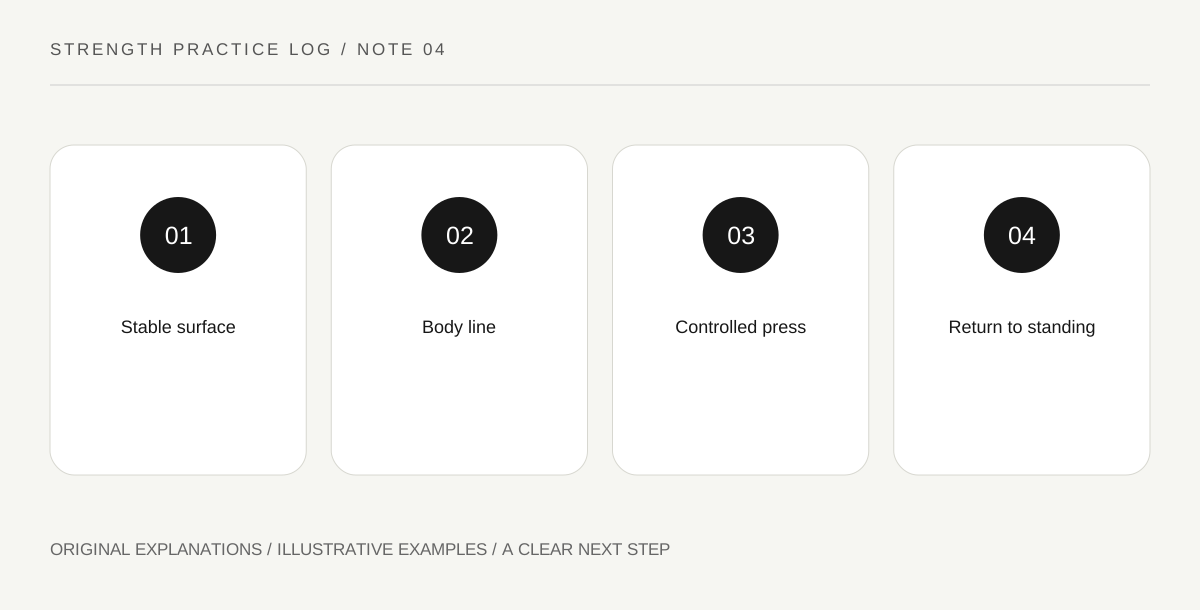
Original explanatory diagram. Read the full method and limitations below.
Identify a surface intended for the task
A suitable fixed training surface differs from a lightweight chair, rolling bench or unverified household edge. Ask the instructor to choose a secure support and explain hand placement. Do not assume that an object is safe merely because it can hold a static hand pressure. The exercise involves movement and changing force. The first decision is a dependable setup, not how low the hands can be placed for a more difficult-looking variation.
Understand the body's moving line
The incline version uses coordinated lowering toward the support and pressing away while maintaining the instructed body control. Ask how your head, torso and legs should relate in the chosen variation. Avoid letting the exercise become a moving hip bend that shortens the pressing task unintentionally. If the position is unclear, use another demonstration or an appropriate easier variant rather than trying to copy a rigid silhouette through discomfort.
Use the height as a version detail
Different support heights create different practical demands, but a lower surface is not automatically the right next step. Learn the current version first and let progression come from an appropriate plan. Record the actual support rather than writing push-ups alone. If you change gyms, a different bench may not recreate the same task. The notebook should preserve enough detail to discuss that difference with the instructor.
Include getting into and out of position
Approach the support, place the hands and establish the body position in a controlled way as taught. Finish before control deteriorates and return to standing appropriately. Do not jump away from an unstable edge because the counted repetitions are complete. A useful practice note identifies the support, movement phase and one question, such as how to keep the instructed line during the return. It does not need to become a record of maximum repetitions to be worthwhile.
Illustrative worked example
Illustrative lesson: A beginner learns the incline push-up on a suitable fixed gym surface selected by an instructor. He records the surface and notices that the hips shift before the arms complete the press. He asks for a cue and keeps the same appropriate version while learning. He does not lower the support simply because another person uses the floor. The example makes no claim about a tested progression schedule.
Questions that come up
Does a higher support make the exercise useless?
No. It defines a different version that may be appropriate for learning. Difficulty should serve the person and plan rather than a visual hierarchy.
Can any table be used?
Do not assume so. Stability, strength, surface and placement matter. Use suitable equipment and qualified guidance rather than an unverified household substitute.
References and scope
These sources support the factual background. Examples and exercises are original illustrative teaching material. References do not imply endorsement.
- NASM Incline Push-Up — Elevated-hand pressing movement and body control.