Keep back support through a seated chest press
A seated chest press provides a backrest and handles for a forward pressing movement. That support should remain part of the exercise throughout the press. Learn the device’s fit and starting position before treating the handle path as a test of how far or heavily you can push.
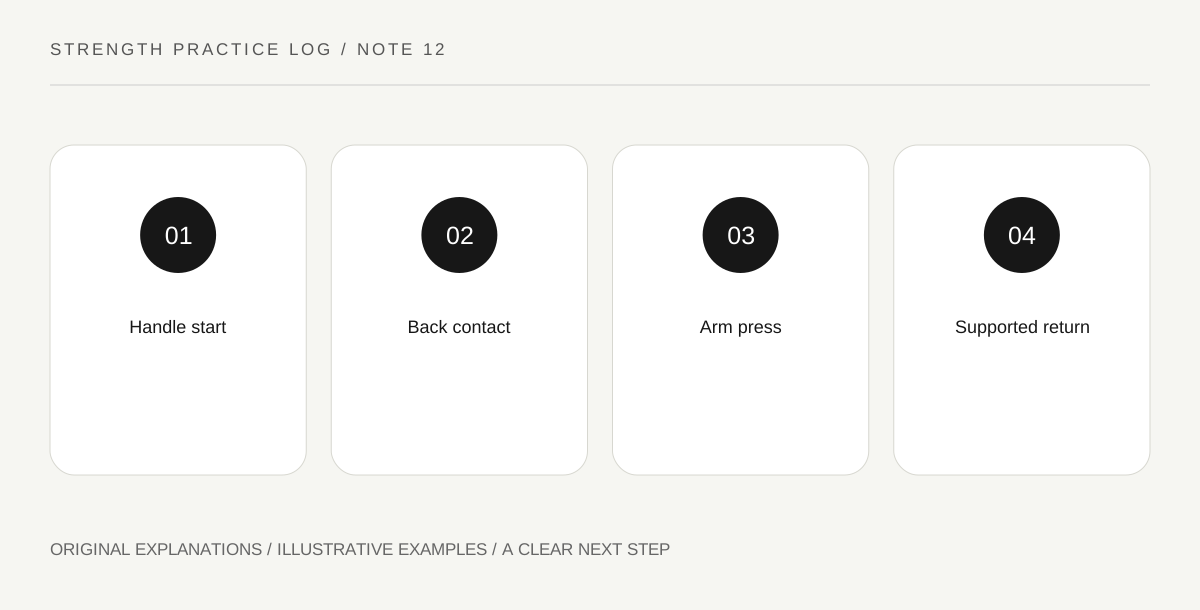
Original explanatory diagram. Read the full method and limitations below.
Set the handle relationship to the chest
In ACE's reference, the handles begin around mid-chest rather than behind the front of the chest. Ask qualified staff to show the appropriate adjustment on your machine. Some designs use a starting-position mechanism as well as a seat adjustment. Learn both where applicable. Reaching a handle does not prove the setup is suitable, and a deeper start should not be assumed to create a better exercise.
Establish the back and foot contacts
Use the backrest and the demonstrated foot support, whether the floor or a designated rest. Check that you understand those contacts before pressing. Avoid arranging the body by forcing a large lower-back arch to reach or move the handles. If the equipment cannot provide an appropriate fit, ask for another option. The lesson concerns the relationship between the support and the press, not a universal posture copied from a different machine.
Press without abandoning the support
As the arms extend, the exercise should not turn into a forward reach that pulls the shoulders and torso away from the backrest. ACE's description keeps the shoulder blades in contact with the support during the press. Ask the instructor to explain the intended endpoint without locking the elbows. The useful observation is whether the pressing action can finish while the chosen contacts remain consistent, rather than whether the handles travel as far as possible.
Treat the return as a separate phase
Bring the handles back deliberately to the appropriate start, preserving the same support arrangement. A sudden return may change the shoulder position before the next press begins. Learn the machine's resting and exit procedure as part of the lesson. Write the device name and relevant adjustment in the notebook, together with the phase that needs attention. That record distinguishes a setup question from an assumption that the next visit should automatically use more resistance.
Illustrative worked example
Illustrative observation: A learner presses successfully but reaches his upper body forward at the end. Staff show him the intended back contact and suitable endpoint on that device. He records a question about finishing the arm movement while keeping support, then reviews the return. The fictional example does not claim injury prevention, prescribe a load or imply that every chest-press machine uses identical settings.
Questions that come up
Should the handles always start as far back as possible?
No. Use the machine’s appropriate demonstrated position. A deeper start is not automatically suitable or more effective.
Is reaching the torso forward part of every press?
The supported press described here keeps the backrest relevant. Ask about the intended endpoint on the actual device rather than adding a forward reach automatically.
References and scope
These sources support the factual background. Examples and exercises are original illustrative teaching material. References do not imply endorsement.
- ACE Seated Chest Press — Machine pressing from the chest and controlled return.